
You know that sinking feeling when you uncover your equipment, only to find it soaked because your “waterproof” tarp wasn’t actually waterproof? Or maybe you’ve watched a cheap blue sheet shred into plastic confetti after just one windy month.
We’ve all been there. It’s incredibly frustrating (and expensive) to keep buying the same flimsies over and over again.
Here is the thing—most people start with standard polyethylene (PE) tarps because they are cheap. But did you know those standard tarps usually only last 1 to 3 years outdoors? Compare that to a high-quality heavy duty pvc tarpaulin, which usually lasts 5 to 10 years.
That is a massive difference.
PVC coated tarpaulin (often called vinyl) isn’t just a plastic sheet; it’s a long-term investment for your business. Whether you need industrial tarps for trucking or waterproof pvc tarpaulin for a construction site, making the switch saves you money in the long run. Actually, it saves you the headache of re-ordering every season, too.
But picking the right pvc tarpaulin material can be confusing. What thickness do you need? What about the specs? Don’t worry, I’ve got you covered. This guide breaks down everything you need to know to choose the perfect tarp so you (hopefully) only have to buy it once.
What is a PVC Tarpaulin and Why is it Superior?

If you pick up a standard blue tarp, it sounds like a bag of chips crinkling. But grab a heavy duty pvc tarpaulin, and it feels solid—more like rubber than plastic.
That difference tells you a lot about the pvc tarpaulin material itself.
Think of a PVC tarp like a heavy-duty sandwich. In the middle, there’s a tough polyester mesh (industry pros call this the “scrim”). This core provides the muscle. Then, manufacturers use a “hot-melt” coating process to fuse liquid Polyvinyl Chloride (PVC) to both sides of that mesh.
Because it’s bonded with intense heat, it becomes one single, unified piece. It is 100% airtight and waterproof. You can’t peel the layers apart, which is exactly why it counts as a waterproof pvc tarpaulin rather than just a water-resistant one.
The Durability Gap
The main reason PVC coated tarpaulin (often just called vinyl) wins is actually chemistry. Without getting too boring, the chlorine atoms in PVC act like an anchor. They hold the molecular structure together much tighter than the simple plastic chains in standard Polyethylene (PE) tarps.
This makes vinyl tarps incredibly stubborn against UV rays, chemicals, and physical abuse.
Check out the difference in raw performance numbers. It’s not even a fair fight:
Feature | Standard PE Tarp | PVC Tarpaulin |
Outdoor Lifespan | 1-3 years | 5-10+ years |
Puncture Resistance | 40-60 lbs | 150+ lbs |
Abrasion Cycles | ~5,000 cycles | 15,000+ cycles |
Tear Strength | 80 lbs/ft² | 220 lbs/ft² |
Look at that abrasion stat. A PVC tarp can withstand rubbing against a truck bed or rusty scaffolding 15,000 times before wearing down. A standard tarp fails at 5,000. That is huge.
It also handles the sun way better. Cheap tarps get “sunburn”—they turn brittle and crack because UV light destroys the plastic. High-quality industrial tarps, especially those from specialized manufacturers like GNC Exports, often include extra UV inhibitors in that thick PVC coating to prevent this.
Basically, you are paying for a material that fights back against the elements instead of just covering them up.
Now, you might be thinking, “Okay, I’m sold on the material, but how thick does it need to be?” That brings us to a little acronym called GSM.
Decoding the Jargon: Understanding PVC Tarpaulin Specifications
Ever look at a product data sheet and feel like you’re reading a secret code?
You see numbers like 1000D, 18×18, and 650GSM thrown around. It is enough to make your eyes cross. But here’s the secret—you don’t need a chemical engineering degree to figure this out. You just need to know three main things to decode pvc tarpaulin specifications.
Let’s strip away the confusion and look at what actually matters for your project.
1. Weight Matters (GSM)
In the tarp world, we measure “beefiness” in GSM, which stands for Grams per Square Meter.
Think of it like clothing. A 150 GSM shirt is a thin summer tee. A 400 GSM hoodie is heavy and warm. If you are looking for a heavy duty pvc tarpaulin, you want a higher number. It essentially tells you how much raw material went into making the tarp.
If the number is too low, the wind will whip it to shreds. If it’s too high, you might break your back trying to lift it.
Here is a quick cheat sheet I use when people ask for a tarpaulin thickness guide:
Application
Recommended Weight (GSM
Real World Fee
Home/Garden
350 – 500 GSM
Sturdy patio furniture cover
Agriculture
450 – 550 GSM
Hay stack cover, light machinery
Trucking
450 – 650 GSM
Tough side curtains for flatbeds
Construction
550 – 1000+ GSM
Heavy scaffolding wraps, industrial floors
Most high-quality industrial covers sit right in that 600 GSM sweet spot. It’s heavy enough to take a beating but light enough to handle without a forklift.
2. The Skeleton (Denier & Mesh)
Remember that “sandwich” analogy from earlier? The meat in the middle is the polyester mesh. This is the skeleton of your pvc tarpaulin material.
Specs will usually show something like 1000D, 20×20.
- Denier (D): This measures the thickness of the thread itself. 1000D is pretty standard for industrial use. 500D is lighter; 1300D is a tank.
- Thread Count (Mesh): This counts how many threads are woven per inch (like 18×18 or 20×20).
Here is where people get tricked. You might see a thick tarp (high GSM), but if it has a weak skeleton (low Denier), it will tear easily when you pull the grommets tight.
For a truly rugged job, look for at least 1000 Denier. That internal gridstops rips from spreading if you accidentally puncture the vinyl.
3. The Special Sauce (Coatings & Protection)
Okay, so you have the weight and the skeleton. But what makes it last in the sun? That’s all in the chemical additives.
A raw plastic sheet will turn yellow and crack in the sun within months. That’s why manufacturers like GNC Exports add specific treatments to the liquid PVC before it coats the mesh.
Sunscreen for your Tarp (UV Treatment)
Unless you are using this tarp inside a cave, you need UV inhibitors. This isn’t usually listed as a number, but you must check the specs to ensure it is UV stabilized. It stops the plastic from baking and becoming brittle.
Fire Retardancy
This is a big one.
If you are covering a haystack or working on a construction site with welding sparks, you can’t have a tarp that acts like kindling. Different regions have different safety codes:
- USA: Look for NFPA 701. It’s the standard text for flame propagation.
- Europe: You’ll likely see B1 (Germany) or M1/M2 (France).
Basically, these ratings mean the tarp might melt if you hold a torch to it, but it won’t burst into flames and spread the fire Understanding Fire Retardant Certifications.
The Finish
Finally, ask about the surface finish. A glossy acrylic or lacquer finish looks nice, sure. But it also does a job—it seals the microscopic pores so dirt and mold can’t dig in. It makes the waterproof pvc tarpaulin roughly 10x easier to clean later on.
It feels like a lot to remember, right?
But honestly, if you just check the GSM and ask, “Is this fire retardant?” you are already ahead of 90% of buyers.
Matching the Tarp to the Task: Choosing the Right PVC Tarpaulin by Use Case

Okay, so we’ve covered the technical stuff like GSM and Denier. But let’s be real—you probably don’t walk into a store asking for “650 GSM with a 1000 Denier scrim.” You walk in saying, “I need something to cover my boat,” or “I need a cover that won’t rip when I drive my truck on the highway.”
You wouldn’t wear a winter coat to the beach, right? The same logic applies here. Buying the thickest tarp possible isn’t always the best move (your back will hate you), and buying the cheapest one is basically throwing money away.
Here is how to pick the right pvc tarpaulin material based on what you actually need it for.
1. For Trucking & Logistics: The Road Warrior
If you are hauling cargo, your tarp is going to war every day. It faces 60+ mph winds, road salt, constant flapping, and that gritty road grime that eats away at lesser materials.
For flatbeds and side curtains, you need a heavy duty pvc tarpaulin that leans on the heavier side.
- Recommended Weight: 600 – 900 GSM (approx. 18oz – 22oz)
- Must-Have Feature: Extreme tear resistance.
Why? Because the Department of Transportation (DOT) doesn’t mess around. Federal regulations require that cargo is strictly secured to prevent shifting or blowing away. If your tarp shreds in the middle of a route, you aren’t just risking your cargo; you’re risking a hefty fine.
Look for industrial tarps with reinforced hems and closely spaced grommets (every 18 inches is standard) so you can ratchet that thing down tight without ripping the eyelets out.
2. For Construction & Industrial Sites: The Safety Shield
Construction sites are full of sharp things—scaffolding edges, rebar, loose nails. A standard blue tarp here lasts about as long as a snowflake in an oven.
You need something that resists punctures. But more importantly, you likely need something that won’t catch fire.
- Recommended Weight: 550 – 750 GSM
- Must-Have Feature: Fire Retardancy.
If you are doing any welding, grinding, or using heaters, safety codes often strictly require flame-retardant materials. Look for labels that mention NFPA 701 (in the US) or B1 (in Europe). These certifications mean the tarp might melt, but it won’t fuel a fire Fire Retardant Standards.
Companies like GNC Exports specialize in these kinds of treated fabrics, ensuring you meet safety compliance without sacrificing strength. It’s worth asking for that certification upfront rather than explaining a safety violation later.
3. For Agriculture & Farming: The Crop Saver
Farmers know that hay mold is a silent wallet-killer. If you are covering hay bales, grain, or expensive machinery, water is the enemy. But so is the sun.
A black plastic sheet might keep rain off, but it accumulates heat like a greenhouse, which causes condensation. That leads to mold. You need a waterproof pvc tarpaulin that is tough but handles the elements intelligently.
- Recommended Weight: 450 – 550 GSM
- Must-Have Feature: UV Stabilization and Mildew Resistance.
PVC naturally fights off mold better than canvas, but specific anti-mildew treatments are a game changer. Also, since these tarps sit out in the baking sun for months, standard PE tarps usually crumble after one or two seasons. A good vinyl tarp here can last 5 to 10 years, saving you from buying replacements every harvest.
4. For Home & Recreational Use: The Backyard Hero
Maybe you just want to cover your patio furniture, a woodpile, or that DIY project in the driveway.
Here is where people make a common mistake: they buy an industrial-grade tarp that is way too heavy to handle. If it takes three people to fold it up, you are never going to use it.
- Recommended Weight: 350 – 500 GSM
- Must-Have Feature: Flexibility and ease of cleaning.
For home use, a lighter vinyl tarp (around 13oz or 450 GSM) is the sweet spot. It is still completely waterproof and way stronger than the hardware store blue sheets, but you can actually fold it up and stuff it in the garage when you’re done.
Plus, since PVC is so smooth, bird droppings and sap wash right off with a hose. No scrubbing required.
Summary Checklist
To make it easy, just ask yourself these three questions before you buy:
- Will it move? (Trucking = High GSM + Tear Strength)
- Is there fire or sharp metal? (Construction = Fire Retardant + Puncture Resistance)
- Will I have to lift it alone? (Home = Lower GSM)
It sounds simple, but getting these pvc tarpaulin specifications right is the difference between a tarp that lasts a decade and one that ends up in the trash next month.
Now that you know what to look for, let’s talk about how to keep that investment in top shape.
Beyond the Basics: Essential Construction Features to Inspect Before You Buy
You’ve picked your weight and you know your application. But wait—don’t hit “buy” just yet.
You can have the thickest pvc tarpaulin material in the world, but if the construction is weak, it’s like putting cardboard wheels on a tank. The fabric might survive, but the edges will fail the first time a storm hits.
I’ve seen expensive heavy duty pvc tarpaulin covers ripped useless in a week because the buyer didn’t look at how it was put together.
Here are the three construction details that separate the pro gear from the cheap stuff.
1. The Grommet Trap
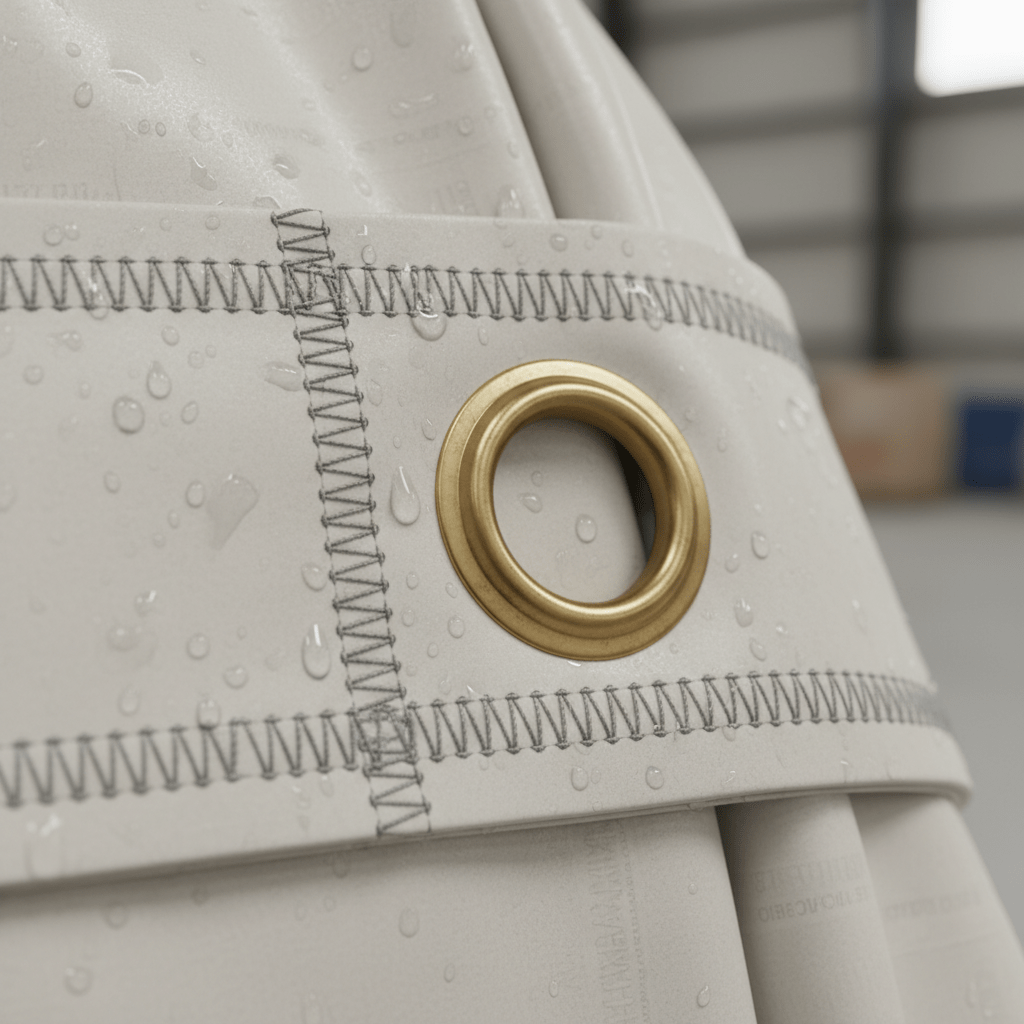
Those little metal rings (eyelets) along the edge? They are usually the first thing to break.
When you pull a bungee cord tight, all that tension focuses on that one tiny ring. If the manufacturer just punched a hole in the plastic and stuck a cheap metal ring in there, it will rip out. Guaranteed.
Here is what you should look for:
- Brass vs. Aluminum: Avoid plain aluminum or plated steel if you can. They tend to corrode or rust, which stains your tarp. Solid brass or stainless steel is the way to go for industrial tarps.
- The Spacing: For heavy use, you want grommets spaced closely together—usually every 18 inches. If they are spaced 3 or 4 feet apart, the wind gets underneath the gaps and acts like a parachute. That creates massive stress Best Grommet Placement.
- Reinforced Webbing: This is the secret weapon. The best tarps have a strip of seatbelt-like material (webbing) sewn or welded into the hem before the grommet is punched. This stops the ring from tearing through.
2. Seams: Stitched vs. Welded
This is a huge debate, but for waterproof pvc tarpaulin, there is really only one winner.
Imagine you want a waterproof coat. Would you poke thousands of tiny needle holes in it? Probably not. But that is exactly what stitching does.
- Stitched Seams: These are fine for breathable canvas, but on PVC, every needle hole checks a box for a potential leak. Water eventually wicks through the thread.
- Heat-Welded Seams: This is superior technology. Machines use hot air or high-frequency radio waves to literally melt the two layers of PVC together. They fuse into a single piece.
Because they are fused, welded seams are 100% waterproof and usually stronger than the fabric itself. If you are covering valuable cargo, always ask if the seams are heat-sealed.
3. Corner Reinforcements
Corners take the most abuse. They flap in the wind, rub against sharp truck edges, and get pulled the tightest.
A standard tarp just folds the material over. But a high-quality pvc coated tarpaulin should have extra patches of vinyl or heavy-duty plastic sewn or welded onto the corners.
Pro Tip: If you need to secure something really heavy, forget grommets entirely. Look for D-Rings. These are metal rings held on by a strap. They pivot, which means they don’t twist the fabric when you tighten them down.
Manufacturers like GNC Exports often offer these customized finishing options because they know that for industrial clients, a tarp is only as strong as its weakest distinct point.
Checking these pvc tarpaulin specifications might seem nitpicky, but it takes about thirty seconds. And trust me, it’s a lot faster than driving back to the store to buy a replacement.
Now that you know what to buy, let’s talk about the money side of things. Is it actually worth paying extra for all this?
Protect Your Investment: How to Maintain and Care for Your PVC Tarpaulin
So, you’ve invested in a solid heavy duty pvc tarpaulin. Good move. These things are built like tanks, usually lasting 5 to 10 years compared to the pathetic 1 to 3 years you get from cheap blue sheets.
But even a tank needs an oil change, right?
Here is the thing—most people kill their tarps by accident. They clean them wrong, or they bundle them up wet. Let’s make sure you don’t do that.
Washing It Down (Without Ruining It)
Dirt happens. When your waterproof pvc tarpaulin gets muddy, your instinct might be to grab the high-pressure washer or some heavy bleach.
Stop! Do not do that.
High pressure acts like a sandblaster and can peel the protective coating right off. Harsh chemicals like bleach or ammonia eat away at the plasticizers that keep the vinyl tarps flexible.
Instead, keep it simple. Use mild soap (like regular dish soap) and warm water. Scrub it gently with a soft sponge or brush, then rinse it off with a garden hose. It’s a bit of work, but it keeps the material healthy.
Storage: The “Bone Dry” Rule
This is the big one. Never, ever fold up a wet tarp.
Even though pvc tarpaulin material is rot-proof, trapped water acts like a greenhouse for mold and mildew. It smells awful and can weaken the stitching over time.
Always lay it out flat and let the sun dry every single drop before you pack it away. Also, if you can, roll the tarp instead of folding it. Sharp creases can eventually turn into cracks after years of sitting in the same spot.
Don’t Toss It, Patch It
Accidents happen. Maybe a sharp tool fell, or a nail snagged the edge.
On a cheap tarp, a hole usually means it’s trash day. But with industrial tarps, you can fix it easily. Because it is made of vinyl, you can use a PVC patch kit.
It works a lot like a tire repair. The special glue (cement) actually melts the patch into the tarp, making it chemically bond together. It becomes 100% waterproof again.
Manufacturers like GNC Exports build these fabrics to handle extreme abuse, but they can’t fight neglect. If you keep it clean and patch the small holes, your tarp will probably outlast the equipment it covers.
Making the Right Choice with Confidence
Phew, we covered a lot of ground. But honestly? It’s better to spend ten minutes reading this now than spending hundreds of dollars replacing a shredded tarp three months from now.
Here is the bottom line. You don’t need to guess anymore. Just stick to the three golden rules we talked about:
- Match the Weight: Don’t buy a heavy tank of a tarp for a patio chair, and don’t buy a lightweight sheet for a semi-truck.
- Check the Build: Look for heat-welded seams and reinforced eyelets. If it’s stitched, it’s going to leak eventually.
- Protect the Skin: UV stabilizers and fire retardancy aren’t optional extras; they are what keep the tarp (and your property) safe.
When you get those pvc tarpaulin specifications right, the math works in your favor. While a standard tarp might give up the ghost in 1 to 3 years, a quality heavy duty pvc tarpaulin is built to stick around for 5 to 10 years. That is a decade of not worrying about rain, rot, or mold.
You are now armed with enough knowledge to spot a bad deal from a mile away. So go ahead—measure your space, pick your specs, and choose a cover that actually works as hard as you do.
Ready to lock in that protection? Explore our selection of application-specific PVC tarpaulins today and get the job done right the first time.
Contact Information
- Mon - Sat: 10:00am-7:00pm
- 4/32-33 Triveni Nagar , Meerpur Cantt , Kanpur-208004
- +91 9839708040 | +91 9936159591
- gncfabrics@gmail.com
Quick Links
- About Us
- Products
- Blog
- Contact Us
© 2024 GNC EXPORTS, All rights reserved. Developed by DIGI PEXEL
- Privacy Policy
- Terms & Conditions
- Cookies Policy